Once dismissed as a draft bust and a system-dependent quarterback, Jared Goff has rewritten his NFL story in dramatic fashion. This in-depth, long-form analysis explores how coaching stability, mental resilience, leadership growth, and the right environment transformed skepticism into belief—making Goff one of the most compelling quarterback comeback stories of the modern NFL era.
Introduction: Why This Quarterback Story Has Captured the NFL’s Attention
The National Football League has always been ruthless toward quarterbacks. No other position is judged faster, criticized louder, or discarded more quickly. Fans, analysts, and franchises often decide a quarterback’s fate within the first two seasons, sometimes even earlier. Once a label sticks—bust, average, system guy—it rarely comes off.
That’s why the story of Jared Goff resonates so deeply with American football fans right now.
Search trends across the United States show a growing fascination with questions like “Was Jared Goff really a bust?”, “How did Jared Goff turn his career around?”, and “Which NFL quarterback revived his career after being written off?” These aren’t casual searches. They reflect a broader curiosity about whether the NFL gets quarterback evaluation wrong—and how often.
Goff’s journey forces fans to confront an uncomfortable truth: sometimes the league doesn’t fail quarterbacks. Sometimes, the environment does.
The Weight of Being the No. 1 Overall Pick
When Jared Goff entered the NFL as the first overall pick, expectations were not just high—they were immediate and unforgiving. Top picks are rarely allowed developmental time. They are expected to elevate struggling franchises instantly.
In Goff’s early seasons, every incomplete pass felt magnified. Every interception became a referendum on his draft position. The scrutiny was relentless.
Real-life context matters here. Young quarterbacks drafted at the top often face:
- Rebuilding rosters
- Coaching turnover
- Media pressure in large markets
- Unrealistic comparisons to established stars
For Goff, this environment shaped perception long before his development curve had time to mature.
How the “Bust” Narrative Took Hold
The “bust” label didn’t appear overnight. It grew gradually, fueled by a combination of factors:
- Inconsistent early performances
- Visible struggles under heavy pressure
- A perception that his success depended entirely on play design
- High-profile losses magnified on national television
Sports talk shows reduced nuance to soundbites. Social media amplified every mistake. Over time, the conversation stopped being about development and started being about replacement.
What often went unmentioned was how rarely quarterbacks thrive amid constant schematic and organizational change.
Winning Wasn’t Enough to Change the Narrative
One of the most ironic chapters of Goff’s career is that winning didn’t silence critics.
Even after leading deep playoff runs and appearing on the league’s biggest stage, doubts lingered. Analysts debated whether success belonged to coaching rather than quarterback play. The phrase “carried by the system” followed him everywhere.
This reveals a harsh NFL reality: quarterbacks are often judged not just on results, but on aesthetics. Efficiency without flash doesn’t inspire belief.
The Trade That Felt Like a Verdict
When Goff was traded to the Detroit Lions, many viewed it as a demotion rather than a fresh start.
The prevailing assumptions were brutal:
- He was a short-term placeholder
- Detroit would draft a new quarterback soon
- His best years were already behind him
Few analysts framed the move as an opportunity. Most framed it as an ending.
They were wrong.
Why Detroit Became the Perfect Reset
Detroit offered something Goff had never truly experienced before: clarity.
Instead of asking him to be a savior, the organization asked him to be a professional quarterback who executed the offense, led the locker room, and improved steadily. Expectations were grounded. Growth was prioritized over optics.
This shift cannot be overstated. Quarterbacks thrive when fear is removed from the equation.
Coaching Stability Changed Everything
One of the defining differences in Goff’s Detroit tenure was coaching consistency.
The offensive system:
- Emphasized timing and rhythm
- Reduced unnecessary risk
- Played to Goff’s strengths rather than exposing weaknesses
Instead of forcing improvisation-heavy football, the scheme rewarded preparation and decision-making. The result was visible not just in statistics, but in confidence.
The Mental Transformation Fans Didn’t See
Quarterback play is as much mental as physical.
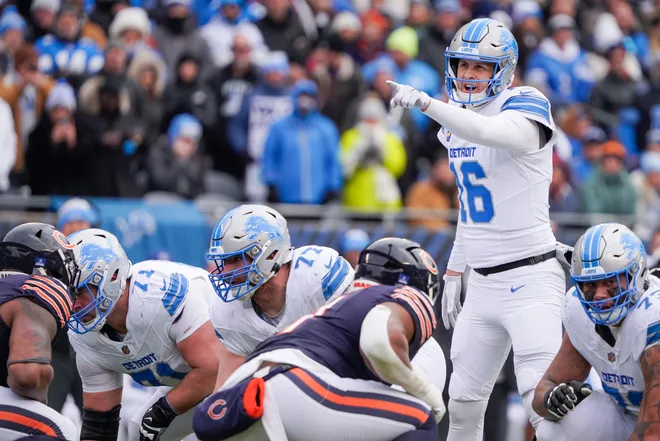
In Detroit, Goff stopped playing defense against criticism. He stopped trying to justify his presence. Instead, he focused on leading teammates and executing assignments.
That mental freedom led to:
- Faster decision-making
- Fewer forced throws
- Improved pocket awareness
- Greater command at the line of scrimmage
Confidence is contagious in the NFL. Once teammates believe in the quarterback, performance accelerates across the offense.
Performance Metrics That Rewrote the Narrative
While debate raged online, numbers quietly told a different story.
Over multiple seasons in Detroit, Goff posted:
- Career-best completion efficiency
- Strong touchdown-to-interception ratios
- Consistent fourth-quarter production
- High success rates against playoff-caliber defenses
Advanced analytics ranked him comfortably among the league’s most reliable starters—not flashy, but dependable. In the NFL, dependability wins games.
Why Fans Didn’t See This Comeback Coming
Several biases worked against Goff’s perception:
- Early labels overshadow later evidence
- Quiet improvement doesn’t generate viral clips
- Market bias favors quarterbacks in glamour franchises
Detroit doesn’t dominate national headlines. Progress there often goes unnoticed—until it becomes undeniable.
Leadership: The Hidden Catalyst
Teammates consistently described Goff using words like:
- Calm
- Prepared
- Consistent
- Trustworthy
Leadership at quarterback isn’t about speeches. It’s about reliability. When players trust the quarterback, they play faster, looser, and more confidently.
That trust became a defining feature of Detroit’s offensive identity.
How This Comeback Fits a Larger NFL Pattern
Goff’s resurgence isn’t an anomaly—it’s part of a broader trend.
Quarterbacks often succeed when:
- Expectations align with skill sets
- Coaching adapts instead of demands
- Development is allowed without panic
The league is slowly learning that early struggles don’t define careers. Environment matters.
What Young Quarterbacks Can Learn From This Story
Goff’s journey sends a powerful message:
- Draft position does not determine destiny
- Early criticism is not a career sentence
- Growth is rarely linear
Patience, alignment, and opportunity can change everything.
Practical Takeaways for Fans and Teams
For fans
- Context matters more than highlights
- Quarterbacks develop at different speeds
For teams
- Fit outweighs flash
- Coaching stability is a competitive advantage
For players
- Confidence grows in the right environment
- Leadership is learned, not assigned
Why “Bust” Is Often the Wrong Conclusion
The NFL doesn’t produce many true busts. It produces mismatches.
Wrong scheme. Wrong timing. Wrong expectations.
Goff wasn’t broken. He was miscast.
Once aligned, belief followed.
Frequently Asked Questions (Trending NFL Searches)
1. Why was Jared Goff labeled a bust?
Early inconsistency, high expectations, and narrative bias overshadowed his development.
2. What changed his career in Detroit?
Coaching stability, schematic fit, and renewed confidence played key roles.
3. Is Jared Goff now an elite quarterback?
He is widely regarded as a top-tier, highly reliable NFL starter.
4. Can quarterbacks revive careers after being traded?
Yes—especially when placed in systems that fit their strengths.
5. What stats show Goff’s improvement?
Completion rate, decision efficiency, and late-game performance improved significantly.
6. Why didn’t fans expect this comeback?
Early labels, lack of hype, and market bias delayed recognition.
7. How important is coaching for quarterbacks?
Extremely important—scheme and trust often determine success.
8. Are “bust” labels usually accurate?
Often no. Many quarterbacks fail due to misalignment, not lack of skill.
9. What can young quarterbacks learn from this story?
Development takes time, and environment matters as much as talent.
10. Will Goff’s story influence future evaluations?
Yes. Teams increasingly emphasize fit and patience in quarterback development.

Final Verdict: Belief Is Built, Not Given
Jared Goff’s transformation from perceived bust to respected leader is not just a football story—it’s a lesson in patience, alignment, and resilience.
In a league obsessed with instant results, his journey proves something powerful: careers are not defined by first impressions, but by adaptation and opportunity.
From bust to believer, this is the NFL quarterback story no one saw coming—until it was impossible to ignore.